
Are Online Degrees Respected? How Employers Actually Judge Them
Whether an online degree is "respected" is mostly the wrong question. Employers rarely evaluate the delivery format; they evaluate the institution, its accreditation and what the credential says about the work behind it. Understand how a hiring decision actually gets made, and the format question shrinks to a footnote — with a few exceptions worth knowing.
What an employer actually checks
For the education entry on a CV, the practical checks are short: is the institution real and recognised, is the degree at the level claimed, and does the field fit the role. Background-check services verify that the degree was conferred by the named institution on the stated date. None of those steps ask how the lectures were delivered.
Where format does surface is in conversation. An interviewer may ask about the programme, and that is where the candidate's own account matters far more than the mode of study. Someone who can describe a capstone project, a team assignment run across three time zones or a supervised placement is answering the underlying question — did this person learn to do the work? — better than any transcript can.
Why accreditation carries the weight
The real dividing line is not online versus on-campus but recognised versus unrecognised. Every system has its own gatekeeping mechanism:
- United States: institutions are accredited by agencies recognised by the Department of Education or CHEA. Accreditation covers the institution as a whole, so its online and campus degrees sit under the same approval. Some fields add programme-level accreditation — engineering, nursing, business, psychology — which matters for licensure.
- United Kingdom: what counts is degree-awarding powers and appearance on the official register maintained by the higher-education regulator. A UK online degree from a recognised body is simply a UK degree.
- Continental Europe: national quality agencies, many listed in the European quality register, approve institutions or programmes, and credits are expressed in ECTS. Recognition across borders follows the Bologna framework rather than the delivery method.
Diploma mills exploit the gap between these systems: they invent accreditors with official-sounding names, award degrees for "life experience" alone, and promise completion in weeks. Our guide to accreditation explains how to check an accreditor against the official lists, and anyone planning to use a degree in another country should also read about degree recognition abroad.
What the diploma and transcript say
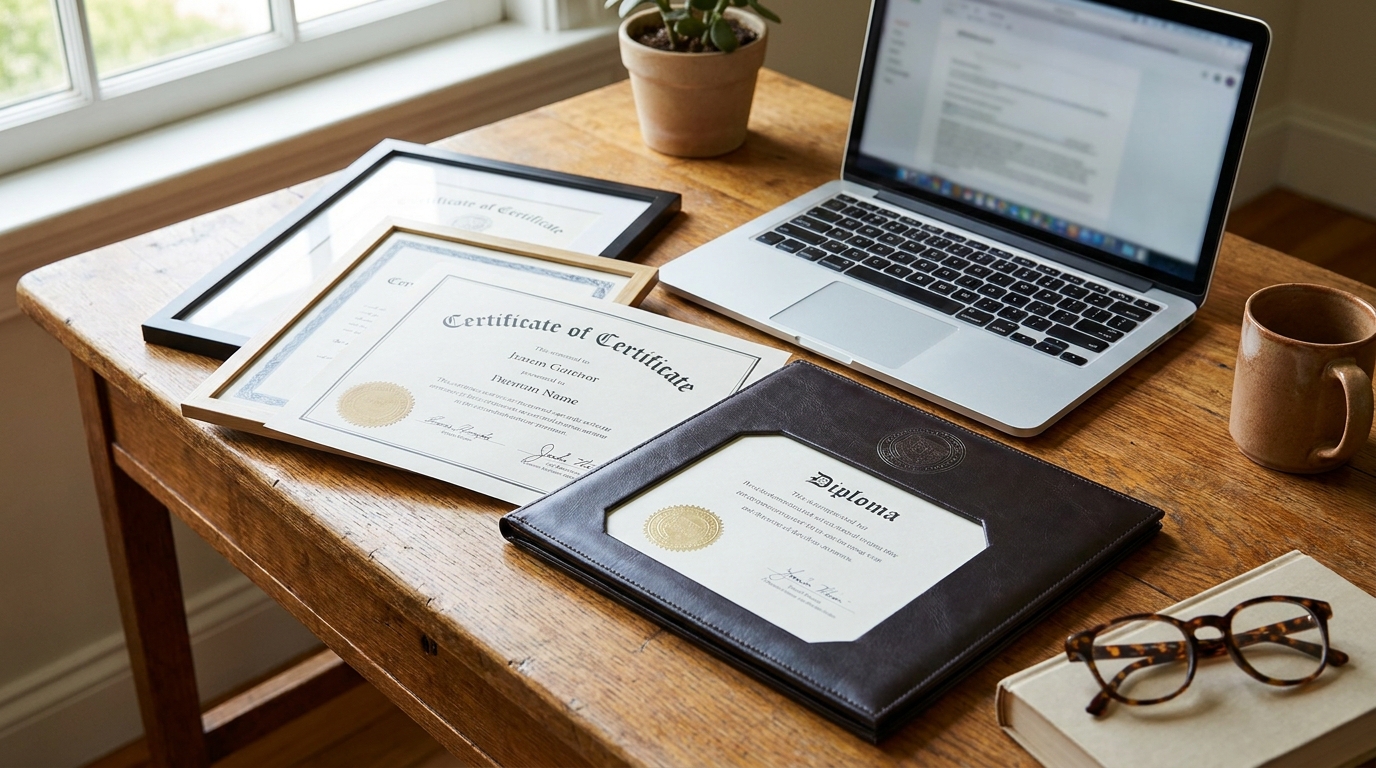
At most established universities, the diploma for an online programme is identical to the campus version: same degree title, same institutional name, no "online" label. Transcripts sometimes differ slightly — a campus code or a section marker — but many institutions deliberately avoid distinguishing modes. That is a policy choice, not a universal rule, so it is worth asking the admissions office directly what the diploma and transcript will show.
Some institutions run a separate brand or division for online and continuing education, and that name may appear on the credential. It is not inherently a problem, but it does mean the degree is read alongside that division's reputation rather than the flagship's.
A worked example: three candidates, one shortlist
A logistics firm is filling an analyst role and has three applicants with business degrees.
- Candidate A completed a fully online bachelor's at a state university that also runs a large campus. The diploma reads "Bachelor of Science in Business Administration," identical to the campus version.
- Candidate B attended a regional private college in person and graduated with similar coursework.
- Candidate C holds a "degree" from an online provider whose accreditor does not appear on any government list. The programme took four months and cost a few hundred dollars.
At screening, A and B are treated the same: both degrees verify at the level claimed, and the interview decides between them. Candidate C is filtered out — not because the degree was online, but because the background check cannot confirm a recognised credential. The format was invisible; the institution was decisive.
Where format still matters
There are real exceptions, and they tend to be specific rather than general:
- Licensed professions — teaching, nursing, counselling, clinical psychology — require supervised practice hours. A programme that cannot arrange placements in your region may not lead to a licence there, however good the coursework.
- Research-heavy fields sometimes favour candidates who have worked inside a lab or alongside faculty, which an online route may limit.
- Some regulated or public-sector employers have their own lists of acceptable institutions, especially for foreign or cross-border credentials.
- Networking and recruiting pipelines at some on-campus programmes — careers fairs, alumni introductions — are harder to replicate online, a genuine cost even when the degree is equal.
Completion is the other quiet issue. Self-paced online programmes typically see more students drift away part-way through, so it is worth reading the institution's graduation rates and outcomes data for the online cohort specifically, not just the campus headline.
How to choose with the employer's view in mind
Confirm accreditation against the official register for its country, and for licensed careers, confirm that the programme meets the licensing body's requirements in the state or country where you intend to work. Ask what the diploma and transcript will say. Look for programmes with real assessed work — projects, supervised practice, proctored exams — because those produce the stories you will tell in interviews.
If the aim is a quicker, narrower signal rather than a full degree, compare the options in our piece on certificates versus degrees first. But if you are choosing between an accredited online degree and its campus equivalent, choose on cost, flexibility and fit. The employer, in most cases, will not be choosing on format at all.

Jonah designed online courses for years before writing about them, so he knows what separates a well-built programme from a recorded lecture series. He covers online degrees, certificates, bootcamps and the practicalities of studying alongside a full-time job.
More about our writers →More in Online Learning

MOOCs for Credit: How Online Courses Connect to University Degrees
Platforms host courses, but only institutions award credit. How MOOC credit pathways and stackable credentials work, and the residency, transfer and recognition limits that decide their value.
Certificates vs Degrees: When a Shorter Credential Is Enough
Professional certificates, industry certifications, micro-credentials and university certificates signal different things. Here is how each compares with a degree, and when one is sufficient.